
Devlok With Devdutt Pattanaik
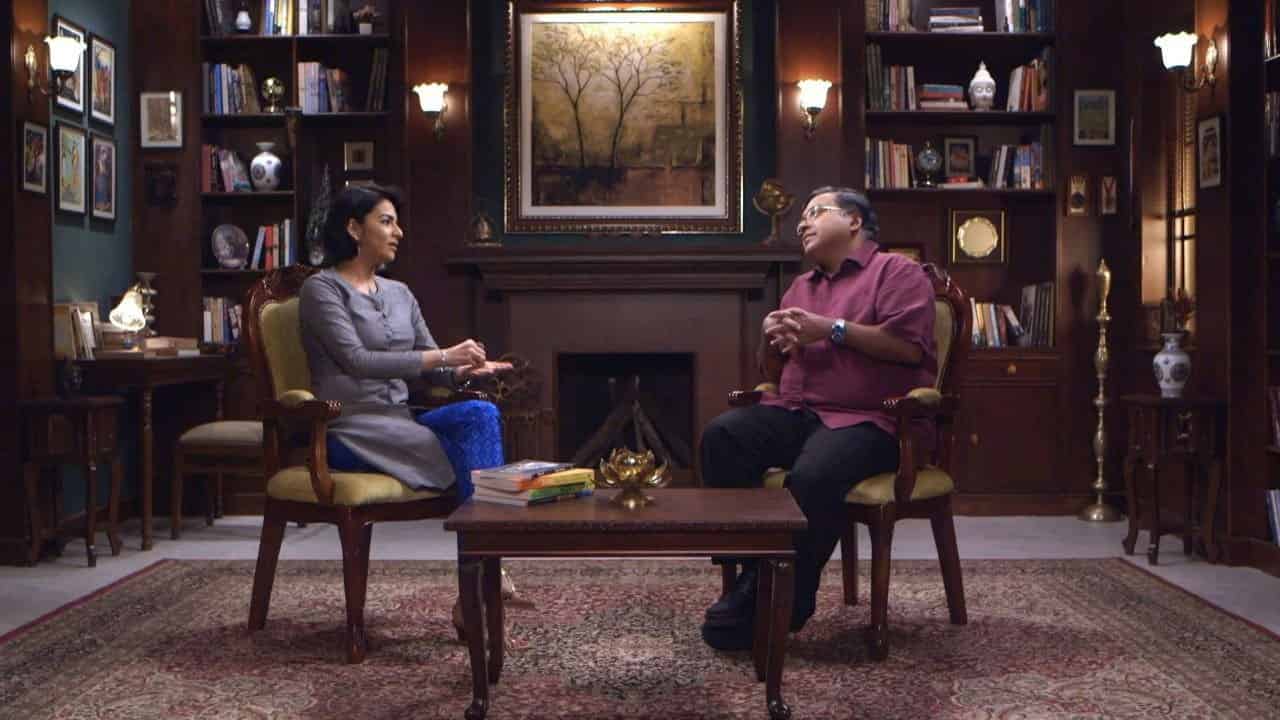
Through chats with host Rasika Dugal, mythologist Devdutt Pattanaik explores the meaning and modern-day relevance of Indian folklore and philosophy.
0 of 73 episodes
0% doneDevdutt Pattanaik uncovers the hidden stories of the greatest epics in Hindu mythology, Ramayana and Mahabharata. Like the Sumerians, Hindus wrote poetic stories which focused on the powers of the gods. Ramayana translates to 'the story of Rama.' It is believed that Valmiki, a Brahmin whose style of writing poetry was carried forward from that point on, wrote the epic.
Trimurti translates as three forms. It is an iconographic representation of God in Hinduism which depicts divinity as a three-faced figure. These three faces represent God's roles of creation, preservation and destruction which are associated with Brahma (the Creator), Vishnu (the Sustainer) and Shiva (the Destroyer).
Colors have deep meaning in Hindu culture beyond decoration. Hindus use specific colors for deities and their clothes to show their traits. Red, green, and saffron are common in rituals. Goddesses Saraswati and Parvati wear red, while Laxmi wears white. Sages wear saffron. Devdutt Pattanaik compares how hermits and householders use colors and shares the story of Holi.
Shiva is one of the most powerful Hindu gods and part of the Trimurti. Known as the Destroyer, he is a complex deity. Devdutt Pattanaik explains that Shiva represents death and destruction, but destruction leads to rebirth and new creation. Life, death, creation, and destruction all exist within him. Devdutt also explores his different forms like Bholenath, Mahadev, and Nataraja.
Hindu mythology features many supernatural beings who live in different worlds, or Lokas, and are children of Brahma. Devas live in Dev-Lok, Asuras in Paa-tal, and Nagas in Nag-Lok. Devdutt Pattanaik compares their traits: Devas are benevolent, Rakshasas are mean and ugly, Yakshas hoard items, and Asuras are obsessed with wealth and power.
Indra Dev is the god of rain and thunder and a primary Vedic deity. Devdutt Pattanaik explains that Indra is often insecure and jealous, leading him to disrupt meditations and cause conflicts among devas. While he was once the supreme king of the devas in the Vedas, his power fades in the Puranas with the rise of the Holy Triad.
Hindu stories use boons for good events and curses for bad ones to explain karma. Devdutt Pattanaik shares examples like King Dasharatha's boon to Queen Kaikeyi, which forced Rama into exile. This tragic event resulted from a past curse given to Dasharatha by Shravan Kumar's parents. The episode explores how these boons and curses shape fate.
In Hinduism, heaven and hell are called swarga and naraka. Heaven is for good souls and devas, while hell brings pain and demons. However, Hinduism also emphasizes that there is no final judgment. Devdutt Pattanaik compares how heaven and hell are viewed across three major religions: Hinduism, Christianity, and Islam, exploring their different concepts and perspectives.
Shakti is the cosmic energy that powers the world and serves as God's dynamic form. Devdutt Pattanaik explains that Shakti is the universal mother goddess of power and creativity. Lakshmi is Vishnu's energy, while Parvati is Shiva's, taking forms like Kali or Durga. The episode explores her incredible omnipotence.
Lord Ganesha is one of Hinduism's most popular deities, representing supreme consciousness in all beings. Devdutt Pattanaik explains that as the son of Shiva and Parvati, Ganesha unifies the followers of both Shiva and Shakti. The episode explores the legends and profound symbolic meaning behind the elephant-headed god.
Hindu deities use powerful weapons called astras, featured in scriptures like the Vedas, Puranas, Ramayana, and Mahabharata. Devdutt Pattanaik explores various divine weapons, their unique traits, and the rules governing their use. The episode focuses on famous astras such as the Sudarshan Chakra, Brahmastra, and Indra's Vajra.
In Hindu mythology, a vahana is a deity's mount that carries or pulls. Devdutt Pattanaik explores these animal mounts, explaining how their traits match the strengths of the deities they accompany. The episode also shares stories about the origins and births of various mounts, which sometimes act independently.
The Ganga is Hinduism's most sacred river, used for prayers, ancestor homage, and ritual water collection called Gangajal. Devdutt Pattanaik explores the river's mythological history and status as a deity. The episode covers her descent from heaven, her relation with deities like Shiva, and her significance across various sects.
The Bhagavad Gita is a sacred Hindu text featuring dialogue between prince Arjuna and Krishna. Devdutt Pattanaik analyzes this text using geography, history, and philosophy analogies. The episode also covers different types of Gitas, translations, and the foundational concepts of dharma and karma.
In Hinduism, yatra or pilgrimage helps people connect with their spiritual goals. Devdutt Pattanaik explores famous pilgrimage centers like Dhams, Kshetras, Peetas, and Melas. The episode discusses the origins, growth, and core concepts behind undertaking spiritual journeys.
In Hindu mythology, deities are associated with specific food offerings to keep them happy. Devdutt Pattanaik discusses favorite foods of various gods, exploring the folklore behind Krishna's love for maakhan, Ganesha's fondness for modaks, and Shiva's affiliation with the bel leaf.
Hindu mythology features four great epochs: Satya Yuga, Treta Yuga, Dwapara Yuga, and Kali Yuga. Devdutt Pattanaik explains the evolution and significance of these Yugas. The episode discusses key events from the Ramayana and Mahabharata, alongside the unique features of Kali Yuga.
Hindu mythology features four great epochs: Satya Yuga, Treta Yuga, Dwapara Yuga, and Kali Yuga. Devdutt Pattanaik explains the evolution and significance of these Yugas. The episode discusses key events from the Ramayana and Mahabharata, alongside the unique features of Kali Yuga.
Devdutt Pattanaik introduces the Dikpalas, the Hindu deities who guard the directions of space. Though rarely worshiped, cardinal guardians include Kubera, Yama, Indra, and Varuna. The episode also explores intermediate directional deities and their temple imagery.
Hindu mythology features stories of divine love and marriage filled with drama. Devdutt Pattanaik discusses how these tales use storytelling to explain deep philosophy. Stories of Shiva with Sati and Parvati illustrate concepts like the hermit and the householder.
In mythology, shape-shifting involves transforming into another form through intellect, divine intervention, or boons and curses. Devdutt Pattanaik explores the concept of shape-shifting in Hindu mythology. The episode discusses theories of changing forms and highlights important examples like Vishnu's form, Mohini.
In Hindu mythology, an avatar is the descent of a deity to Earth, most notably associated with Vishnu to restore dharma. Devdutt Pattanaik introduces Vishnu's avatars, discussing the Dashavatara and its regional variations. The episode also covers human forms like Parashurama, Rama, and Krishna in detail.
Nakshatras and grahas-representing star constellations and astrological figures-are important elements of Hindu mythology. Devdutt Pattanaik shares stories about prominent nakshatras. The episode also touches upon the deep-seated Hindu belief that the positions of these celestial bodies influence human lives.
In Hindu mythology, sacred trees and plants like the peepal, bel, banyan, and amla are deeply revered. Devdutt Pattanaik shares stories from the Vedas and Puranas explaining their associations with specific deities. The episode also covers worship methods and proper planting directions.
Puja is a key act of showing reverence to the divine in Hindu mythology. Devdutt Pattanaik explains different types of puja, yagnas, temple abhishekas, and festivals like Durga Puja. The episode highlights how these rituals serve as a means for devotees to connect with the divine.